
Blower Selection: Matching Airflow to Basin Demand
Oversized or undersized blowers both cost you money and process stability. Here's how airflow demand should actually drive selection.
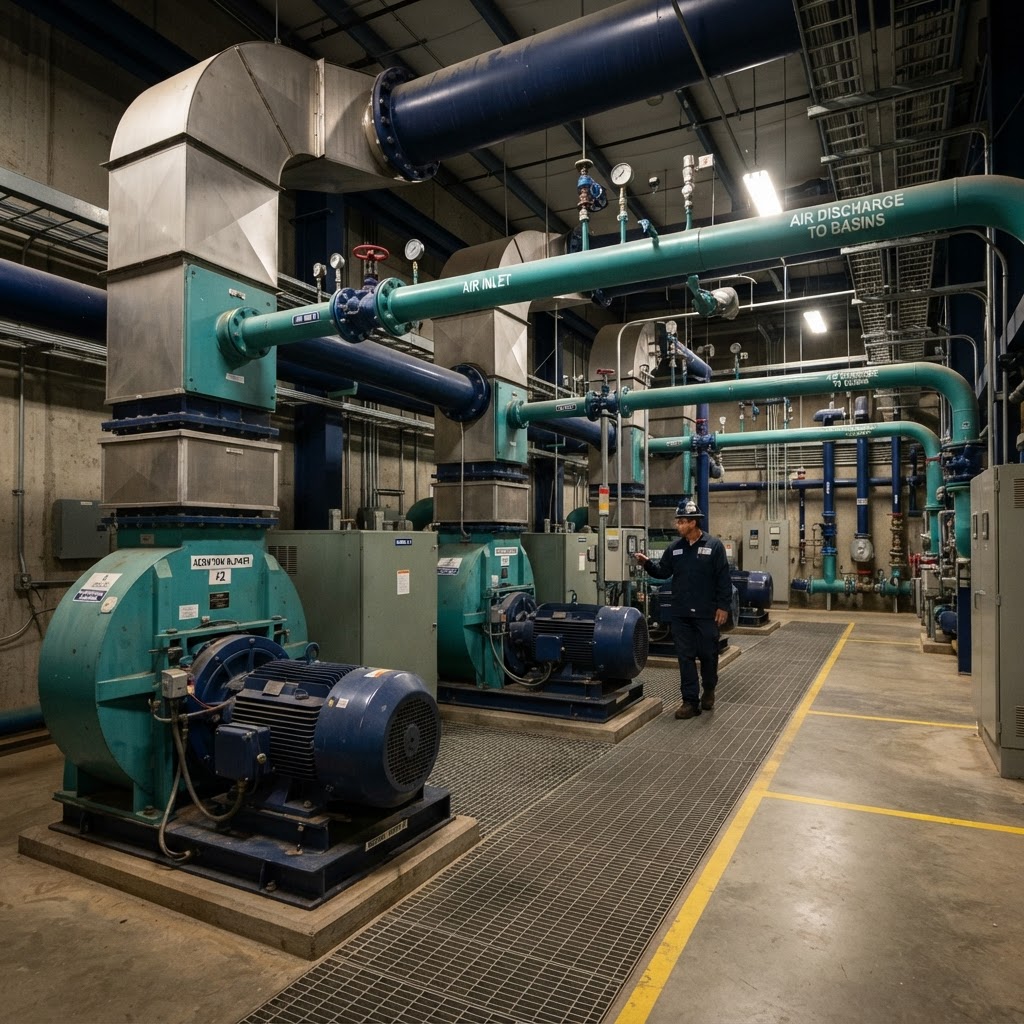
Blowers are one of the biggest energy consumers at most wastewater plants, so getting the sizing and selection right has real operational and budget consequences. The starting point isn't the blower catalog, it's your basin's actual oxygen demand.
Oxygen demand depends on your organic loading (BOD or COD coming in), your target MLSS, and how much nitrification you're trying to achieve, since ammonia oxidation requires significantly more oxygen per pound than BOD removal alone. Calculate your Actual Oxygen Requirement (AOR) first, then convert to Standard Oxygen Requirement (SOR) accounting for temperature, elevation, and diffuser efficiency, this is the number that should actually drive blower selection, not a rule-of-thumb horsepower-per-basin-volume estimate.
Centrifugal blowers (including modern turbo blowers with magnetic bearings) tend to perform best at higher, steadier flows and offer strong efficiency at a fixed operating point, but efficiency drops off if the plant's load swings widely throughout the day. Positive displacement (rotary lobe) blowers handle variable demand and low-flow conditions more gracefully, at some cost to peak efficiency.
Many plants get the best of both by running multiple smaller blowers instead of one large unit, this lets you match delivered airflow to real-time demand by staging units on and off, rather than throttling a single oversized blower far below its efficient operating range. Combined with DO-based automatic control, staged blowers can cut energy costs substantially compared to constant-speed operation.
Before any blower replacement or expansion project, pull at least a year of DO and loading data if you have it. Sizing to your actual demand curve, not your busiest hypothetical day, is what keeps a blower system efficient for the two decades it's likely to be in service.
Elevation and ambient temperature both change how much oxygen a given blower can actually deliver, and this is a common oversight in sizing done off catalog numbers alone. Air density drops at higher elevations and in hotter climates, meaning the same blower moving the same volumetric airflow delivers fewer pounds of oxygen per hour than it would at sea level on a cool day. Always confirm catalog performance curves have been corrected for your plant's actual site conditions, not standard reference conditions.
Turndown range is another factor that gets overlooked until a plant is already operating outside it. Every blower has a minimum stable operating point below which centrifugal units risk surge (a damaging pressure oscillation) and positive displacement units lose efficiency sharply. If your basin's demand swings widely between night and day flows, check that your selected blower's turndown range actually covers your full operating window, not just your average case.
Maintenance access and redundancy should factor into selection as much as efficiency curves. A single large blower with no functioning backup means a bearing failure takes your entire aeration system offline. Most well-designed plants size for N+1 capacity at minimum, enough total blower capacity to meet peak demand even with the largest single unit out of service, and stagger maintenance schedules so redundancy is never accidentally reduced to zero.
Finally, factor in the control system, not just the blower itself. A highly efficient blower paired with manual, infrequent adjustment captures only a fraction of its potential savings. DO-based automatic control, PID-tuned to avoid excessive cycling, is usually what turns a good blower selection into the energy savings the sizing calculation promised on paper.
When comparing blower options during a capital replacement decision, evaluate the full operating range, not just the rated design point; a blower that's efficient at its nameplate flow but poor at the partial loads your plant actually runs most of the time (nights, low-flow seasons) can cost more in lifetime energy use than a slightly less efficient blower with a flatter efficiency curve across its turndown range.
Inlet air filtration maintenance deserves the same attention as the blower itself; a fouled inlet filter forces the blower to work harder for the same delivered airflow, showing up as rising energy cost long before it triggers an obvious alarm or performance complaint.
Don't stop at the article.
The industry's most useful newsletter, straight from the plant floor.
One email. No fluff. New lessons, equipment breakdowns, and process control notes, delivered when there's something worth reading.