
Fine Bubble vs. Coarse Bubble Diffusers: What the Data Actually Shows
The efficiency gap between fine and coarse bubble aeration is bigger than most retrofit decisions treat it.
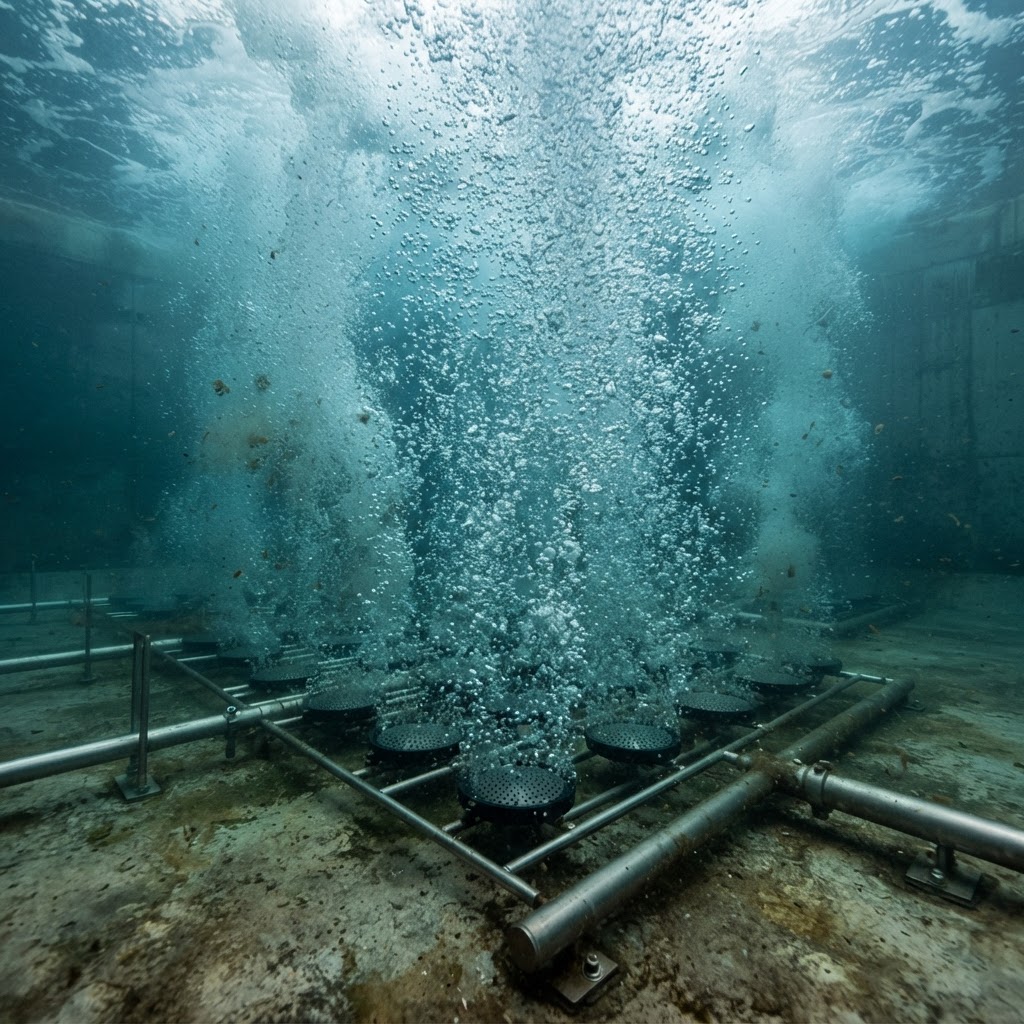
The case for fine bubble diffusion comes down to surface area. A given volume of air broken into smaller bubbles has dramatically more surface area in contact with the surrounding water, and since oxygen transfer happens at that interface, smaller bubbles transfer oxygen far more efficiently per cubic foot of air delivered.
In practice, that difference is large: fine bubble ceramic or membrane diffusers typically achieve 25–35% standard oxygen transfer efficiency (SOTE), while coarse bubble systems usually land in the 10–15% range. Because blower energy is often a plant's single largest electrical cost, that gap translates directly into a meaningful annual utility bill difference, not just a theoretical process improvement.
The tradeoff is maintenance. Fine bubble membranes and ceramic discs foul over time from biological growth and mineral scaling, gradually dropping SOTE and raising the backpressure the blower has to work against. Coarse bubble diffusers are far more fouling-resistant and mechanically simpler, which is why some plants, particularly those with limited maintenance staff or highly variable, debris-heavy influent, still choose them deliberately.
If you're evaluating a retrofit, don't rely on the manufacturer's clean-water SOTE number alone. Ask for the fouling factor and expected efficiency loss over a cleaning cycle, and compare that against your realistic maintenance capacity. A fine bubble system that never gets cleaned on schedule can underperform a well-maintained coarse bubble system in year three, even though it wins on paper in year one.
Whatever system you run, track blower discharge pressure at a constant airflow setpoint over time. A slow upward creep is usually your earliest, cheapest warning that diffusers need cleaning before efficiency losses show up on the power bill.
Diffuser layout and density across the basin floor matter as much as the diffuser technology itself. Even a high-efficiency fine bubble system underperforms if diffusers are clustered too densely in one zone, creating oxygen-rich dead zones next to under-aerated corners. A well-designed layout accounts for basin geometry and mixing patterns, not just total diffuser count, and retrofits that simply swap technology without revisiting layout often disappoint on delivered efficiency.
Water depth interacts directly with bubble contact time, and it's an underappreciated lever in the fine-versus-coarse decision. Deeper basins give bubbles more time in contact with the water before reaching the surface, which favors fine bubble systems even further since the efficiency advantage compounds with contact time. Shallow basins narrow the efficiency gap between fine and coarse bubble systems, which is one reason coarse bubble diffusion still shows up more often in shallower lagoon-style systems.
Alpha factor, a correction that accounts for how actual wastewater (with its surfactants, solids, and biology) transfers oxygen less efficiently than the clean water used in manufacturer SOTE ratings, is essential for realistic comparisons. Alpha factors for fine bubble systems in mixed liquor often run 0.5–0.7, meaning real-world transfer efficiency is well below the clean-water number on the spec sheet. Always ask for alpha-corrected performance data when comparing systems, not just clean-water SOTE.
Cleaning method and frequency should be part of the total cost comparison, not an afterthought. In-basin cleaning systems (automated bubblers or acid recirculation) reduce labor compared to pulling diffusers for offline cleaning, but add their own capital and chemical costs. Run the full lifecycle cost, including realistic cleaning frequency based on your influent characteristics, before assuming the technology with better efficiency on paper is actually the lower-cost choice over a diffuser's service life.
When evaluating a diffuser retrofit, request SOTE test data from the manufacturer under conditions matching your basin's actual depth and airflow, not just published lab values from an idealized clean-water test tank; real-world alpha factor (the efficiency penalty from process water compared to clean water) varies enough between plants that generic published numbers can overstate expected performance.
Budgeting for periodic diffuser cleaning as a planned maintenance line item, rather than reactive replacement only after performance visibly degrades, extends fine bubble diffuser service life meaningfully and keeps blower energy costs from creeping upward unnoticed.
Don't stop at the article.
The industry's most useful newsletter, straight from the plant floor.
One email. No fluff. New lessons, equipment breakdowns, and process control notes, delivered when there's something worth reading.