
Chemical Feed Systems: Getting Dosing Right
Metering pump calibration, injection point placement, and mixing energy determine whether a chemical dose actually does what the jar test predicted.
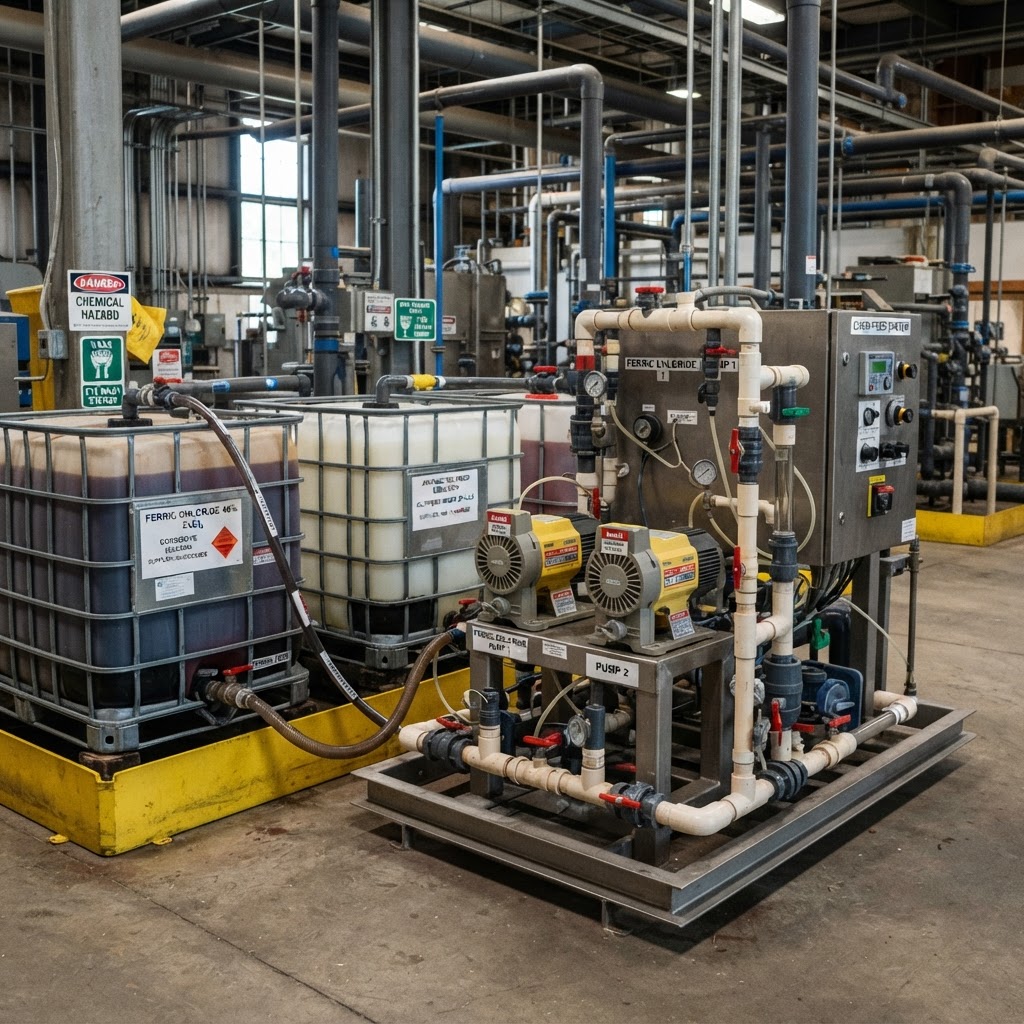
A chemical feed system that's dosing the wrong amount rarely announces itself directly. Instead, it shows up as a phosphorus limit exceedance, a disinfection residual that won't hold, or a polymer bill that keeps climbing without a corresponding improvement in cake solids. Most of these problems trace back to one of three places: pump calibration, injection point design, or mixing energy, not the chemistry itself.
Metering pump calibration drifts more than most operators assume. Diaphragm and peristaltic metering pumps are typically rated to within 1-3% accuracy when new and properly calibrated, but diaphragm wear, tubing degradation (on peristaltic units), and back-pressure changes downstream all shift actual output away from the dial setting over time. A pump that hasn't been drawdown-tested (measuring actual volume pumped over a timed interval against the displayed rate) in the past few months is running on an assumption, not a verified number. This matters enormously for chemicals dosed near a permit limit, since a 15% calibration drift on a phosphorus removal chemical can be the difference between compliance and a violation.
Injection point placement determines whether a chemical actually contacts the water it needs to treat before the reaction window closes. Coagulants like ferric chloride or alum need turbulent mixing immediately at the injection point to disperse before hydrolysis reactions begin, dosing into a calm, low-velocity channel dramatically reduces effective treatment even at the correct chemical rate. Disinfectants need injection upstream of enough contact time and mixing to achieve a uniform CT value across the full flow, not just at the pipe centerline. If dosing rate looks correct on paper but performance is inconsistent, checking the physical injection point and mixing conditions is often more productive than adjusting the rate further.
Polymer activation and aging matter more than most O&M manuals emphasize. Dry polymer needs adequate mixing energy and activation time (typically 30-60 minutes) to fully hydrate before use; emulsion polymers need proper inversion mixing to break the emulsion and release the active polymer. Polymer solution that's been sitting too long (typically beyond 24-72 hours depending on product and dilution) degrades and loses effectiveness, a common hidden cause of "polymer isn't working" complaints that are actually aging problems, not dosing rate problems.
Chemical storage and day-tank management affects dosing accuracy indirectly but significantly. A day tank that's allowed to run low and get refilled inconsistently changes the concentration feeding the metering pump, since most plants dose based on a calibrated volumetric rate assuming a consistent stock concentration. Standardizing dilution water ratios and maintaining consistent day-tank fill procedures removes a variable that's easy to overlook when troubleshooting a dosing problem.
Before assuming a chemical dosing problem requires a rate change, verify the three fundamentals in order: pump calibration (is it actually pumping what the display says), injection point (is mixing energy adequate at the point of contact), and solution age/concentration (is what's in the tank still what you think it is). Adjusting the dose rate without checking these first often masks the real problem and can make the actual root cause harder to find later.
A useful diagnostic sequence when a chemical feed complaint comes in: first confirm the pump is actually delivering its displayed rate via drawdown test, then check the injection point for adequate mixing, then check solution age and concentration in the day tank. Working through these three in order, rather than jumping straight to a dose rate change, resolves the majority of real-world dosing complaints without ever touching the setpoint.
Documenting each metering pump's drawdown test result over time, not just the pass/fail outcome, builds a maintenance record that predicts replacement timing before a pump fails during a critical dosing period.
Don't stop at the article.
The industry's most useful newsletter, straight from the plant floor.
One email. No fluff. New lessons, equipment breakdowns, and process control notes, delivered when there's something worth reading.