
DMR Reporting Mistakes That Turn Into Violations
Most reportable DMR violations aren't water quality failures — they're paperwork and sampling errors that were preventable.

A surprising share of NPDES violations have nothing to do with actual treatment performance. Discharge Monitoring Report (DMR) errors, missed samples, late submissions, and calculation mistakes, get treated by regulators exactly the same as an exceedance, even when your effluent quality was fine the entire time.
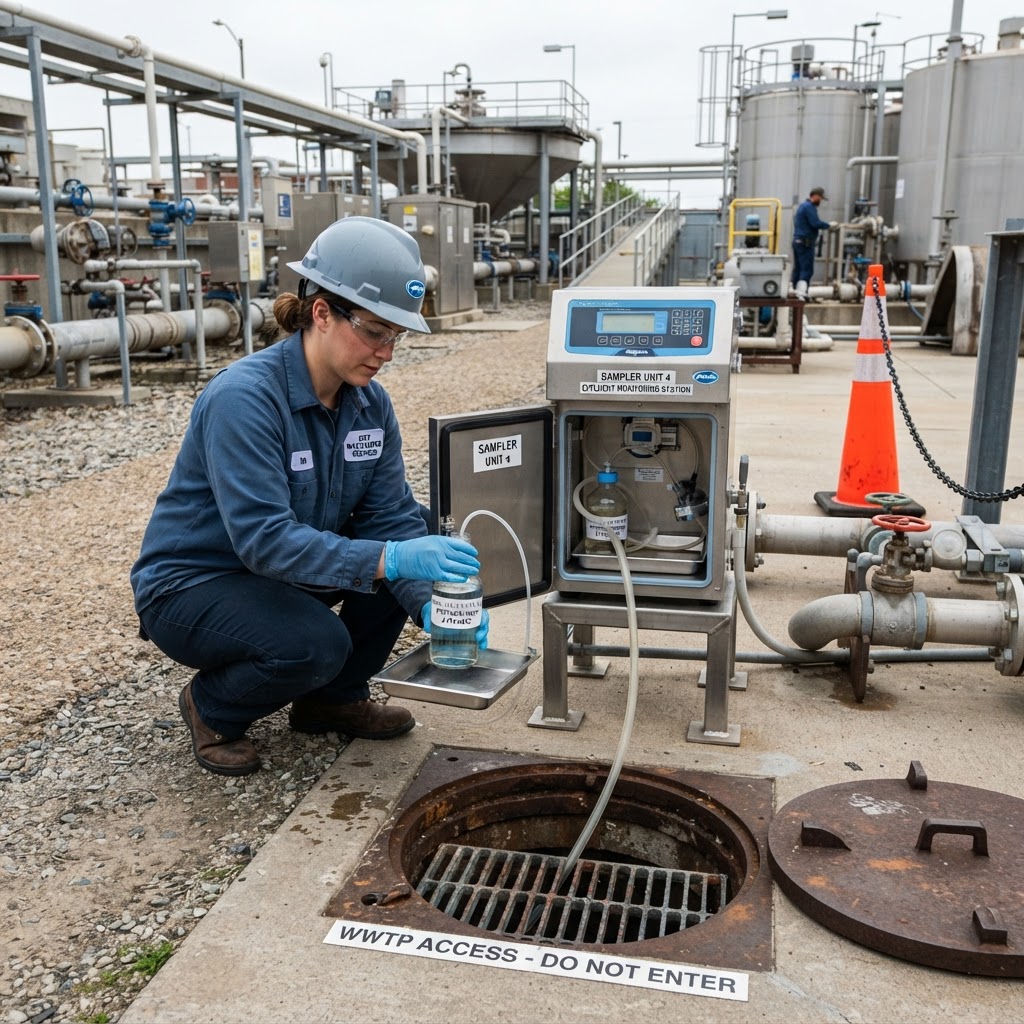
Missed or invalid samples are the most common trap. If your permit requires a composite sample and a grab sample gets substituted due to equipment failure, that sample is often invalid even if the number itself looks compliant. Document any deviation from your approved sampling method immediately and contact your regulatory agency proactively, a documented equipment failure with a corrective action plan is treated very differently than an unexplained gap discovered during an audit.
Calculation errors on the DMR itself are the second-biggest source of preventable violations, particularly with mass-based limits. A concentration limit exceedance and a mass loading exceedance are different calculations, and it's possible to be compliant on one and not the other. Double-check unit conversions (mg/L to lbs/day requires the 8.34 factor and your flow for that period) before submitting, and have a second person independently verify any manual calculation before it goes out.
Holding time violations are quietly common and often invisible until an inspector cross-references your lab receipt times against your sample collection log. Every parameter has a maximum holding time between collection and analysis; a sample analyzed even a few hours late can invalidate an otherwise-correct result.
The fix for nearly all of these isn't better science, it's a documented, followed procedure: a written sampling schedule, a two-person review before DMR submission, and a habit of contacting your regulator the moment something goes wrong rather than after the fact. Agencies consistently respond better to early disclosure than to a violation they find on their own.
Electronic reporting adds its own failure points that didn't exist with paper DMRs. EPA's NetDMR system and most state equivalents have submission deadlines that are strictly enforced by the system itself, and a login credential that's expired or a certification signatory who's changed jobs without updating their access can turn a completed report into a late submission through no fault of the data itself. Build in a buffer of at least a few days before your actual deadline, and verify signatory access is current well ahead of any reporting period.
Limit types are also frequently confused in ways that create paperwork violations. Permits often specify different limits for daily maximum, weekly average, and monthly average for the same parameter, each calculated differently. Reporting a single sample result as if it satisfies a monthly average requirement, when the permit actually requires averaging multiple samples across the period, is a common and entirely avoidable error that shows up during compliance audits.
When a genuine exceedance does occur, how it's reported matters almost as much as the exceedance itself. Most permits require narrative explanation for any reported exceedance, and a DMR submitted with a bare number and no context reads, to a regulator, very differently than one accompanied by a clear explanation of cause and corrective action already taken. Building a habit of drafting that narrative immediately, while the details are fresh, produces far better documentation than reconstructing it weeks later during an inspection.
Finally, treat your DMR review process itself as something to audit periodically, not just the data going into it. A quarterly internal check, confirming the current permit limits match what's programmed into your reporting spreadsheet or software, and that the person responsible for second-review is still assigned and available, catches the kind of drift that turns a good system into a source of preventable violations over time.
A practical internal check worth building into your DMR review process: have someone other than the preparer independently recalculate at least the parameters closest to their permit limit before submission. Fresh eyes catch transposition and unit errors far more reliably than the same person re-checking their own work.
Maintain a running log of near-miss DMR errors caught before submission, not just actual violations. This internal record reveals whether errors cluster around a specific parameter, calculation, or time of month, pointing to a process gap worth fixing at the source rather than continuing to catch the same mistake manually every reporting period.
Don't stop at the article.
The industry's most useful newsletter, straight from the plant floor.
One email. No fluff. New lessons, equipment breakdowns, and process control notes, delivered when there's something worth reading.