
Understanding Industrial Pretreatment Programs
Local limits, permitting, and inspection frequency: what a pretreatment coordinator actually manages, and why it protects the entire plant.
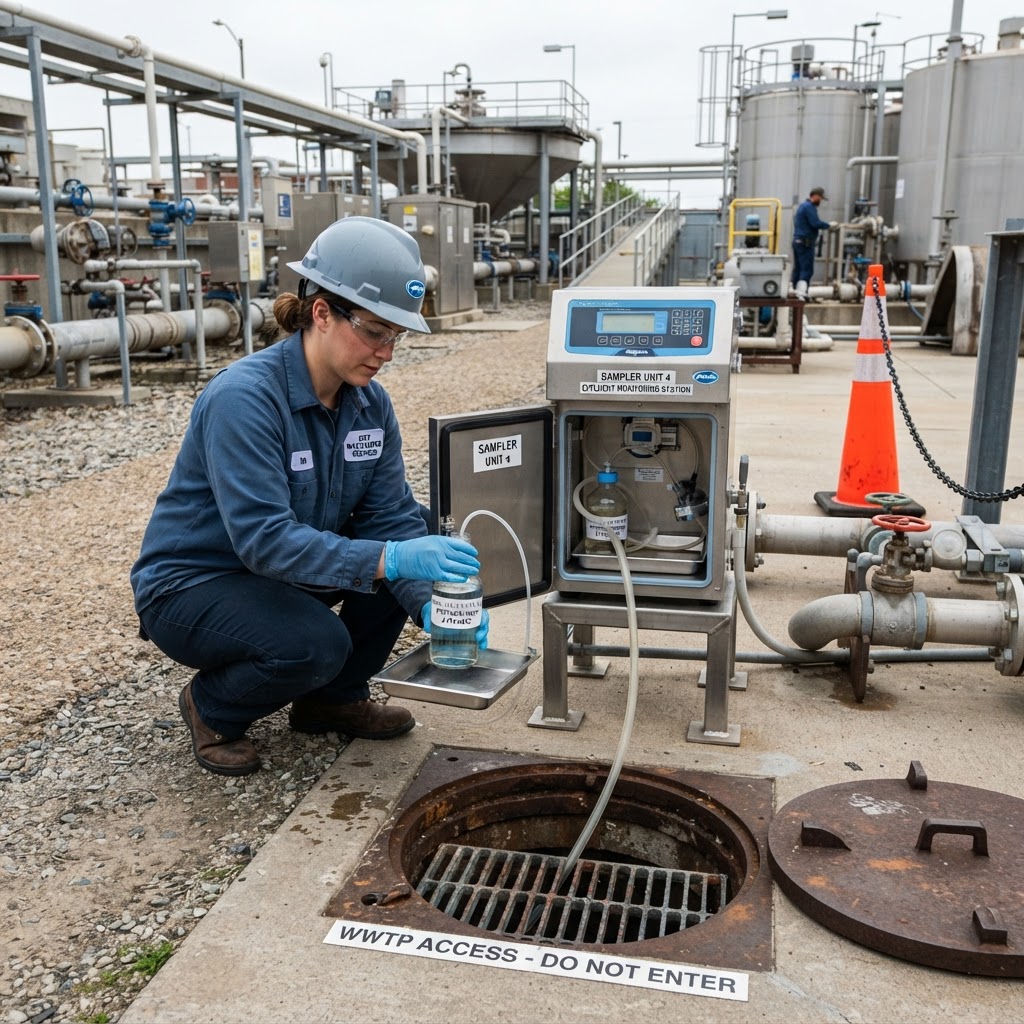
An industrial pretreatment program exists because a single non-compliant industrial discharger can undo months of careful process control at the plant in a single slug load. EPA requires publicly owned treatment works above a certain size, or those receiving discharge from certain industrial categories, to run a formal pretreatment program, but even smaller utilities without a mandated program benefit from understanding how the framework works.
Local limits are the technical foundation of any program, and they're not the same as federal categorical standards. Categorical standards (set by EPA for specific industry types, like metal finishing or organic chemicals manufacturing) establish a floor, but local limits are calculated specifically for your plant based on its actual treatment capability, NPDES permit limits, and headworks loading capacity. A pretreatment coordinator (or engineering consultant) calculates local limits by working backward from what the plant's biological process and effluent permit can tolerate, then allocating that capacity across the industrial user base. Getting this calculation wrong in either direction either leaves the plant exposed to toxicity events or imposes unnecessarily strict limits that invite legal challenges from permitted industries.
Permitting significant industrial users (SIUs) is the ongoing administrative core of the program. An SIU is generally defined as a discharger meeting certain flow or categorical thresholds, and each one needs an individual discharge permit specifying allowable pollutant concentrations, monitoring frequency, and reporting requirements. Permits typically run on a 5-year renewal cycle, and renewal is the point where local limits get revisited against updated plant data, not just automatically re-issued at the prior numbers.
Inspection and sampling frequency is where many programs fall short of their own permit requirements, usually due to staffing constraints rather than intent. EPA guidance generally expects SIUs to be inspected and sampled at least annually, more frequently for higher-risk categorical industries. A program that's behind on its inspection schedule is exposed during an EPA or state pretreatment audit even if no actual discharge violations have occurred, since the audit looks at program compliance, not just industry compliance.
Enforcement response needs to follow a documented, escalating structure, typically informal notice, then formal notice of violation, then compliance schedule or administrative order, then civil penalty, applied consistently across all industrial users regardless of size or relationship with plant staff. Programs that enforce inconsistently (strict with a small business, lenient with a major employer) create legal exposure and undermine the program's credibility during the next permit renewal review.
The payoff for running this well shows up in the plant, not just in a filing cabinet of permits: fewer unexplained toxicity events, more predictable influent loading, and a documented paper trail that protects the utility if a discharge violation ever does cause a plant upset and the utility needs to demonstrate it wasn't negligent in managing its industrial users.
A useful annual exercise for any pretreatment coordinator is a headworks loading mass balance: sum the permitted allocations for every SIU and compare that total against the plant's actual demonstrated treatment capacity. A program where allocated capacity has crept close to, or past, actual capacity over years of incremental permit issuance is exposed to a toxicity event even if every individual industrial user is currently in compliance.
Training plant operations staff to recognize and report signs of a potential industrial slug load, an unusual color, odor, or foaming pattern arriving with a specific pump station's discharge, extends pretreatment program awareness beyond the coordinator's own inspection schedule.
Don't stop at the article.
The industry's most useful newsletter, straight from the plant floor.
One email. No fluff. New lessons, equipment breakdowns, and process control notes, delivered when there's something worth reading.