
Filamentous Bacteria: Identifying and Fixing Bulking Sludge
A rising SVI and a settling sludge blanket that won't compact usually trace back to one of a handful of well-known filament types, each with a different fix.
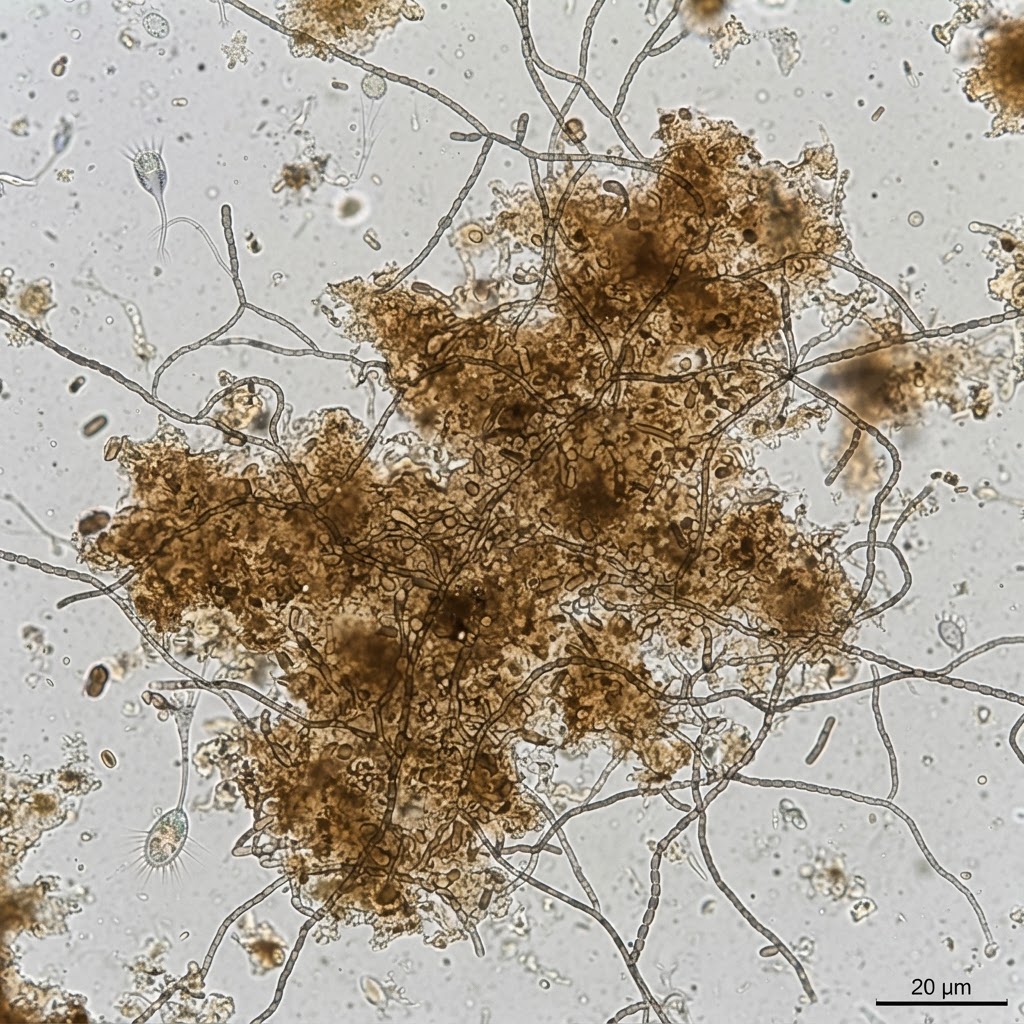
Bulking sludge, where the settled sludge volume stays high and won't compact no matter how long you let it settle, is one of the most common process upsets operators face, and it's also one of the most misdiagnosed. Because the visible symptom (poor settling, rising SVI, solids carryover) is the same regardless of the underlying cause, operators sometimes treat every bulking event the same way. The actual fix depends heavily on which filamentous organism, or non-filamentous cause, is responsible, and a microscope is the fastest way to find out.
A wet mount microscope exam, even a basic 100x-400x look, tells you more in ten minutes than a day of guessing based on F/M and DO trends alone. You're looking for filament abundance (none, few, common, excessive) and, if trained observers are available, filament type based on morphology, branching pattern, and gram stain reaction. This doesn't require a specialized microbiology background to get useful information; even distinguishing "lots of filaments extending outside the floc" from "dense, compact floc with almost no filaments" (the latter suggesting a different cause entirely, like a deflocculation or dispersed growth issue) points you toward the right fix.
Low DO filaments (Type 1701, Sphaerotilus natans) are the classic cause and the one operators check first, appropriately, since it's usually the easiest to confirm and fix. These filaments thrive when DO drops below roughly 1.0-1.5 mg/L in zones where they're actively growing. If your DO trend shows sustained low readings and the filament exam shows Type 1701-consistent morphology, raising DO to a solid 2.0+ mg/L and holding it there for one to two sludge ages typically resolves it without any other intervention.
Low F/M (starvation) filaments (Nocardia, Microthrix parvicella) show up when the system is running at an unusually low food-to-microorganism ratio, often from over-aggressive wasting, low influent loading, or an extended SRT beyond what the plant needs. Nocardia in particular causes thick, greasy foam in addition to poor settling, a visual tell that distinguishes it from most other filament-driven bulking. The fix here runs opposite to the low-DO case: reduce SRT (increase wasting) to raise F/M back into a normal range, rather than adjusting aeration.
Septic or low-pH conditions (Thiothrix, Beggiatoa) point toward sulfide exposure, often from septic influent or an anaerobic zone that's gone too reducing. These filaments are frequently identifiable by visible sulfur granules under the microscope. Addressing the upstream septicity, reducing detention time in force mains or wet wells, or improving pre-aeration, is the actual fix; chasing DO or SRT changes at the aeration basin won't touch a collection-system-driven cause.
Once you've corrected the root cause, expect recovery to take one to two sludge ages, the same timeline as most other biological process corrections. Adding anti-filamentous agents like chlorine or hydrogen peroxide to selectively kill filaments can provide short-term settling improvement during a severe event, but it treats the symptom, not the cause, and repeated use without fixing the underlying DO, F/M, or septicity issue will keep you cycling back to the same problem every few weeks.
Building a simple in-house reference log, dated microscope photos paired with the process data (DO, SRT, F/M) recorded that same day, turns every bulking event into training material for the next one. Over a year or two, this reference becomes far more useful for fast diagnosis than any external textbook, since it reflects your specific plant's actual filament history.
Worth remembering: more than one filament type can be present simultaneously, particularly during a transitional upset. If a fix targeting one filament type doesn't fully resolve settling problems, a follow-up microscope check for a second, less dominant filament is a reasonable next step before assuming the first diagnosis was wrong.


Don't stop at the article.
The industry's most useful newsletter, straight from the plant floor.
One email. No fluff. New lessons, equipment breakdowns, and process control notes, delivered when there's something worth reading.