
SCADA and Process Control: A Plain-English Primer
SCADA screens look intimidating until you understand what they're actually built to show you. Here's the plain-English version.
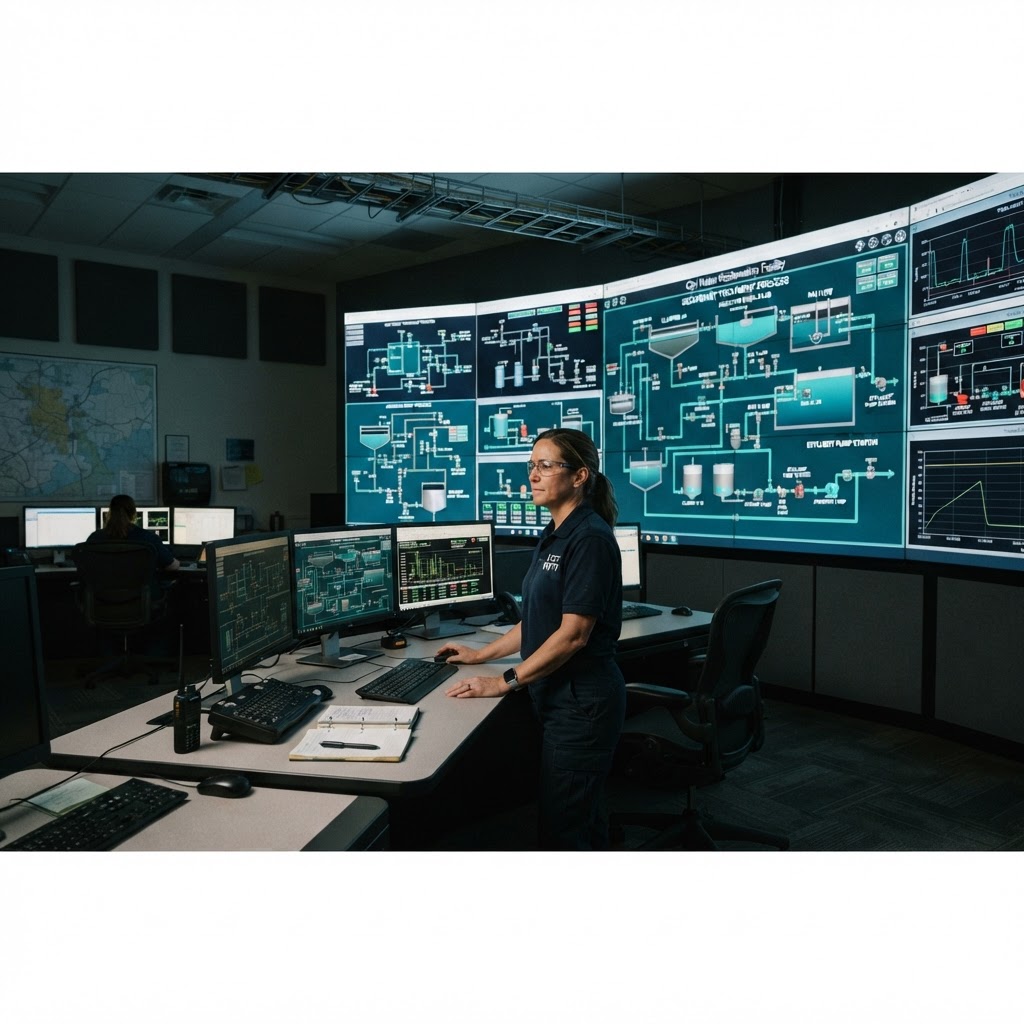
SCADA, Supervisory Control And Data Acquisition, sounds more complicated than it is. Strip away the acronym and it's really just a system for watching your plant from one screen and, in many cases, adjusting it from that same screen instead of walking to every valve and panel individually.
At the core of any SCADA system are sensors and instruments scattered across the plant: dissolved oxygen probes in the aeration basin, level transmitters in wet wells, flow meters on the influent line. These feed data back to a central system through PLCs (Programmable Logic Controllers), which are the small industrial computers actually doing the real-time thinking at each piece of equipment.
The screen you interact with, the Human-Machine Interface, or HMI, is just a visual layer on top of that data. Trend graphs let you see whether DO has been drifting for the last six hours. Alarm summaries flag when a value crosses a threshold you or your engineer set. None of this replaces operator judgment; it just gives you the information faster than physically checking every point manually.
Where SCADA earns its reputation for complexity is in the control logic behind the screen, the if-this-then-that rules that decide when a blower ramps up or a pump kicks on. Understanding a handful of key setpoints for your plant (DO targets, pump start/stop levels, chemical feed rates) will get you further than trying to memorize the whole system at once.
Start by learning to read trends, not just live values. A single DO reading tells you almost nothing; a DO trend over the last shift tells you whether your aeration control is actually stable. That shift in thinking, from single numbers to patterns over time, is what turns SCADA from a wall of confusing screens into your most useful tool on the floor.
Most modern SCADA platforms layer in historian software, which stores every tag (each sensor point) at a set interval, often every few seconds to every minute, for months or years. This is what lets you pull up 'ammonia over the last 90 days' instead of only ever seeing the live number. Learning to use the historian, not just the live HMI screen, is usually the single biggest skill jump for an operator moving from reactive troubleshooting to proactive process control.
Alarm management deserves special attention because poorly tuned alarms are one of the most common complaints about SCADA systems. If every minor deviation triggers an alarm, operators start ignoring the alarm panel altogether, a phenomenon called alarm fatigue that has caused real missed-response incidents industry-wide. A well-tuned system uses tiered alarms: informational notices for minor drift, real alarms for values approaching a permit or process limit, and critical alarms reserved for conditions requiring immediate action.
Redundancy and cybersecurity are increasingly part of the SCADA conversation. Many utilities now run backup PLCs or dual communication paths so a single network switch failure doesn't blind the control room. Because SCADA systems are also increasingly connected to remote access and reporting tools, segmenting the control network from general IT infrastructure and enforcing strict access controls has become a standard recommendation from both engineers and state regulators.
For operators studying for certification, remember that SCADA questions on exams typically test conceptual understanding, not brand-specific software. Know the general architecture, sensor, PLC, HMI, historian, and you can apply that framework to whatever specific system your plant runs, even as vendors and screens change over a career.
A SCADA system is only as reliable as its alarm configuration; too many low-priority alarms trains operators to tune out notifications, a phenomenon known as alarm fatigue that has contributed to real missed-response incidents industry-wide. Periodically reviewing and pruning alarm setpoints to keep only genuinely actionable alerts active is as important as the initial system design.
Document a manual backup procedure for every critical SCADA-controlled function before you need it during an outage, not while troubleshooting one live; knowing exactly how to manually operate a blower, pump, or valve if its control loop fails is a basic resilience requirement, not an advanced one.
Don't stop at the article.
The industry's most useful newsletter, straight from the plant floor.
One email. No fluff. New lessons, equipment breakdowns, and process control notes, delivered when there's something worth reading.