
Understanding Biosolids Regulations Without the Legal Jargon
Federal biosolids rules exist to answer one core question: is this material safe for how you intend to use or dispose of it?
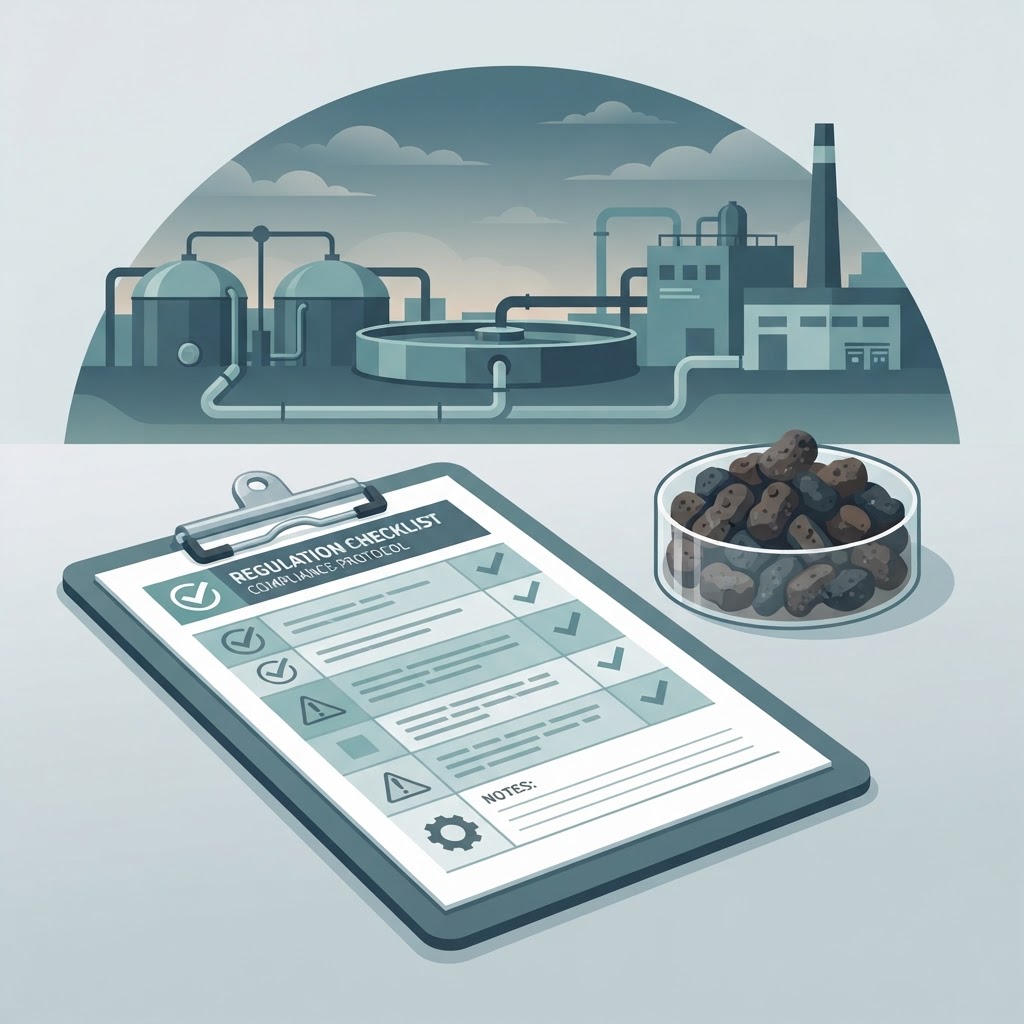
Biosolids regulation in the U.S. is built around 40 CFR Part 503, and while the legal text is dense, the underlying logic is simple: biosolids are classified by how much pathogen reduction and metal removal they've undergone, and that classification determines what you're allowed to do with them.
Class B biosolids have reduced pathogen levels but still require site restrictions, buffer zones, crop harvesting delays, and public access limits, when land-applied. Class A biosolids meet a much higher pathogen reduction standard (through processes like extended composting, heat drying, or advanced digestion) and, once they also meet vector attraction reduction requirements, can be land-applied with far fewer restrictions, including use in bagged products sold to the public.
Separately from pathogen class, every biosolids product is also subject to pollutant limits for nine metals, including arsenic, cadmium, and lead. Plants track cumulative loading rates for land application sites to ensure metals don't build up in soil over time, this is where good recordkeeping on your end matters just as much as your treatment process.
Vector attraction reduction (VAR) is the piece operators sometimes overlook: even biosolids with excellent pathogen reduction must also demonstrate they won't attract flies, rodents, or other vectors, typically through volatile solids reduction, injection below the soil surface, or alkaline treatment.
The practical takeaway for plant staff: know which class your biosolids process is certified to produce, keep your monitoring records current, and never assume a process change (a new polymer, a different digestion time) doesn't affect your certification, even small process shifts can move you between classes if pathogen or VAR performance drifts.
Beyond the federal Part 503 framework, many states layer on additional requirements that are often stricter than the federal minimum, and it's a mistake to assume federal compliance automatically satisfies state permit conditions. Some states require more frequent metals testing, additional pathogen indicators, or tighter buffer zones for land application than 40 CFR Part 503 specifies. Always check your state environmental agency's biosolids program requirements as the controlling standard when they exceed federal rules.
Vector attraction reduction (VAR) is a separate requirement from pathogen reduction that trips up newer operators. Even biosolids that meet Class A pathogen standards must also demonstrate they won't attract disease vectors like flies and rodents, typically through volatile solids reduction, alkali addition, or drying to a specific solids content. Meeting pathogen requirements without meeting VAR requirements still leaves a plant out of compliance.
Record-keeping requirements under Part 503 are extensive and are one of the more common sources of enforcement action, separate from any actual contamination issue. Plants generating biosolids must retain records covering pathogen and VAR compliance methods, metals concentrations, and land application site information for at least five years, and some site-specific records must be kept longer. An otherwise fully compliant biosolids program can still generate violations from incomplete recordkeeping alone.
Per- and polyfluoroalkyl substances (PFAS) have become the fastest-moving area of biosolids regulation. Several states have already introduced PFAS testing requirements, land application restrictions, or disclosure rules for biosolids ahead of any finalized federal PFAS biosolids rule, and EPA has signaled further rulemaking is coming. Plants land-applying biosolids should treat PFAS as an active compliance area to monitor closely, since state-level rules are shifting faster than federal guidance in this specific area.
A practical compliance habit: maintain a single reference document mapping which specific biosolids management practice your plant uses (land application, Class A production, landfill disposal, incineration) to its exact corresponding Part 503 pathogen and vector attraction reduction requirement, rather than relying on institutional memory. Staff turnover is one of the more common causes of a biosolids compliance gap going unnoticed for a reporting cycle.
Keep beneficial-use land application records organized by field and application date, not just by total annual volume; a regulator or land owner inquiry about a specific application event is far easier to answer from organized per-event records than from reconstructing history from aggregate annual totals.
Don't stop at the article.
The industry's most useful newsletter, straight from the plant floor.
One email. No fluff. New lessons, equipment breakdowns, and process control notes, delivered when there's something worth reading.